When Should SMEs Make the Switch?
Every company operates differently. Because of this, developing a custom system is not always the best decision.
The real question is not whether a custom system is better.
The real question is when the compromises of off-the-shelf software start to hurt your operations.
When is off-the-shelf software enough?
Pre-built tools are often the right choice when:
- you work with a small team
- your processes are simple and well defined
- you do not need custom workflows
- the goal is fast implementation with low cost
In these situations, the most important factor is immediate usability without development work.
For many early-stage companies, this approach works perfectly.
When should you consider a custom system?
The turning point usually appears when:
- your processes no longer fit the logic of standard software
- several different tools must be connected together
- manual administration increases the risk of mistakes
- growth requires automation that the system cannot provide
- full control over business data becomes important
At this stage, the compromises of standard tools are no longer savings.
They become operational limitations.
Practical questions before building your own system
Before investing in a custom solution, it is worth asking a few key questions.
- How much time and money does the current tool save — and how much do the compromises cost?
- Does the current system support growth, or slow it down?
- Can the system evolve with the company, or will it eventually require a complete restart?
- Are your processes adapting to the software — or is the software adapting to your processes?
If the first situation is true, it may be time to rethink the direction.
The real dilemma for most SMEs
Fully custom development is often expensive and slow.
Off-the-shelf software is fast to implement, but limited in flexibility.
Because of this, most companies are not truly choosing between these two extremes.
They are searching for a flexible foundation they can build on over time.
Why IntrApp can be a practical middle ground
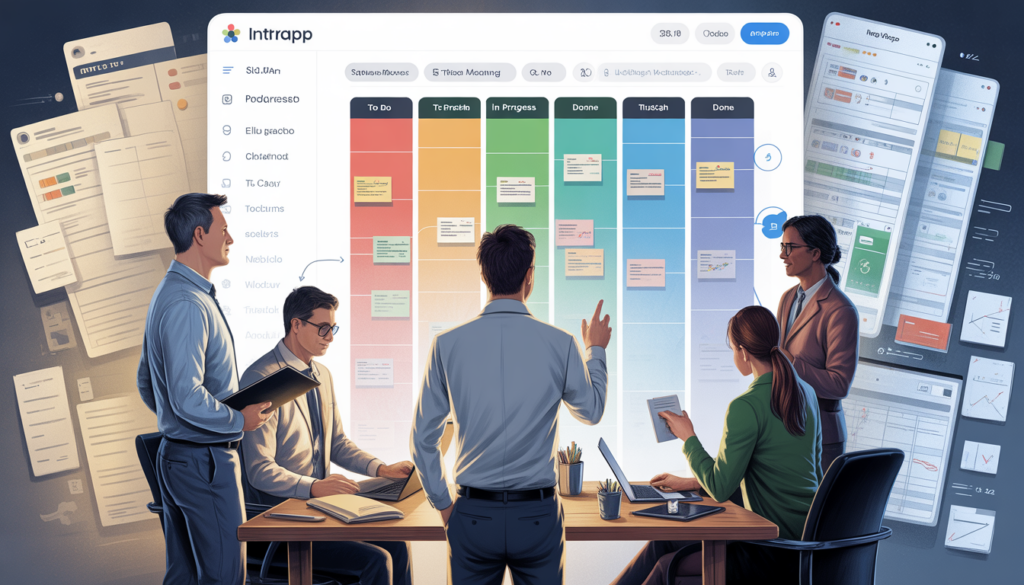
IntrApp provides a balance between ready-to-use software and flexible system development.
It offers:
- built-in core features such as CRM, projects, tasks, and internal communication
- the ability to replace several disconnected tools
- a secure, closed internal system
- modular expansion as the company grows
- short development cycles for adapting processes
It is not a custom system built from scratch.
But it is also not a rigid, inflexible software product.
Instead, it provides a scalable foundation that can evolve together with the company.