English
Open the demo
Internal system for SMEs

Plenty of platforms, or none at all? IntrApp helps with what your company does day to day, and nothing else.

In IntrApp the project comes with the customer, the documents and what you agreed about them, so six months later you can still say who promised what. You do not need an administrator either, the setup runs by itself in about half an hour, and your own instance is ready to work in.

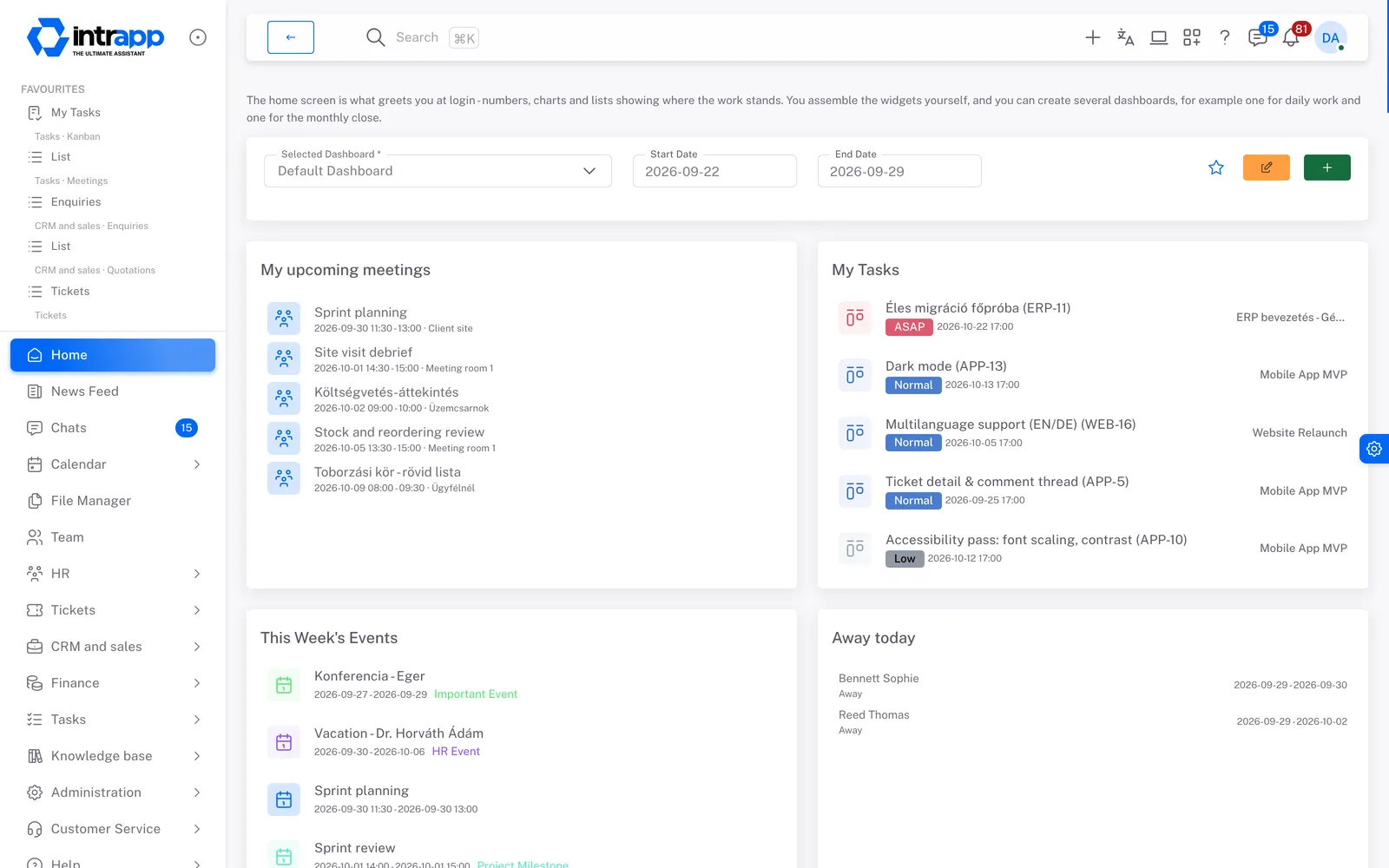
The IntrApp home screen with time logged this week, your own tasks, your own tickets and this week’s events.

You are choosing a system right now

What you are looking at is probably strong at one thing each. The customer tool knows the customer, the project tool sees the board. The question is not which one goes deepest, but which one keeps the work, the customer and what you agreed in the same place. That is the question IntrApp was built for.
When a custom system is worth it

You already work in five or ten programs

The quote is in an email, the deadline on a piece of paper, the contract somewhere on the shared drive. Nothing is lost, you just have to ask someone for everything. You do not have to replace it all at once. Most companies start with one area and cancel something only once they can see it is not missed.
Why separate tools slow you down
The problem we saw

Every company has one person who keeps it all in their head

That works while they are there.

They know where the quote is, what you promised the customer, and which folder the contract is in. The day they go on holiday or resign, you find out how much was resting on them. Nobody planned it this way. It just ended up like this.

If you are choosing a system now, the decision comes down to whether the system will know what this person knows today. If you already have plenty of programs, none of them knows it, because each one only sees its own part.

Our answer

What IntrApp actually is

IntrApp is the Business Operating System the company runs on, not another program at the end of the queue.

What we noticed is that a working week at a small company looks much the same everywhere. A job comes in, it gets an owner, it has a deadline, it belongs to a customer, documents gather around it, and people talk about it as it goes. The industry differs. The shape of the work does not.

So we built an application on that, not several separate programs to be wired together. The customer shows up on the task because the task belongs to them, and the contract attaches itself to the customer.

There are no hidden costs and no paid extra modules, so everyone gets the same thing, and the price depends on how many of you there are and how much storage you need. Every subscriber gets everything, because half a system is not a system.

Before you compare it

Not a CRM and not an ERP

Both serve a different purpose. A CRM knows your customers and nothing about the work. An ERP was built for companies a few sizes up, along with the rollout project that comes with it.

Yes, for any single job there is a stronger tool than ours, and if one area is the business for you, say pure sales or warehousing, choose that instead. At an average small company that is rarely the problem. Far more often the problem is that one job is spread across several systems, and somebody holds the connections in their head.

A specialist tool is excellent at one job and does not hold the whole workflow together, which is exactly what causes the scatter. That is what IntrApp is for, because it keeps the work in one piece from beginning to end, not just one slice of it.

Why it is this simple

Your whole internal operation in one system

Large systems can do an enormous amount. They have a field, a status and a permission setting for every conceivable case, and that is not an accident, because at some point somebody needed each one.

The trouble is that most of that depth is neither understood nor used by most of the people who have it. At an average company the case it was built for often never comes up, while the complexity arrives anyway, along with the training.

So we looked at what a small company actually does day to day, and built the system around that. Every screen is designed so that somebody opening it for the first time on a Monday morning can use it, and when something is unclear, the built-in manual and the walkthrough explain it right where they got stuck. Everything is where you would look for it, dated, open to comment and there to read back later.

What you would use once a year is not in it. That has a price, and we would rather say so. The how it works page lists what we deliberately do not do.

What is in it

How IntrApp is put together

These are not extras, they are the system itself. All of them work on the same data, which is why the customer, the document and the conversation are there next to the task.

Projects & tasks

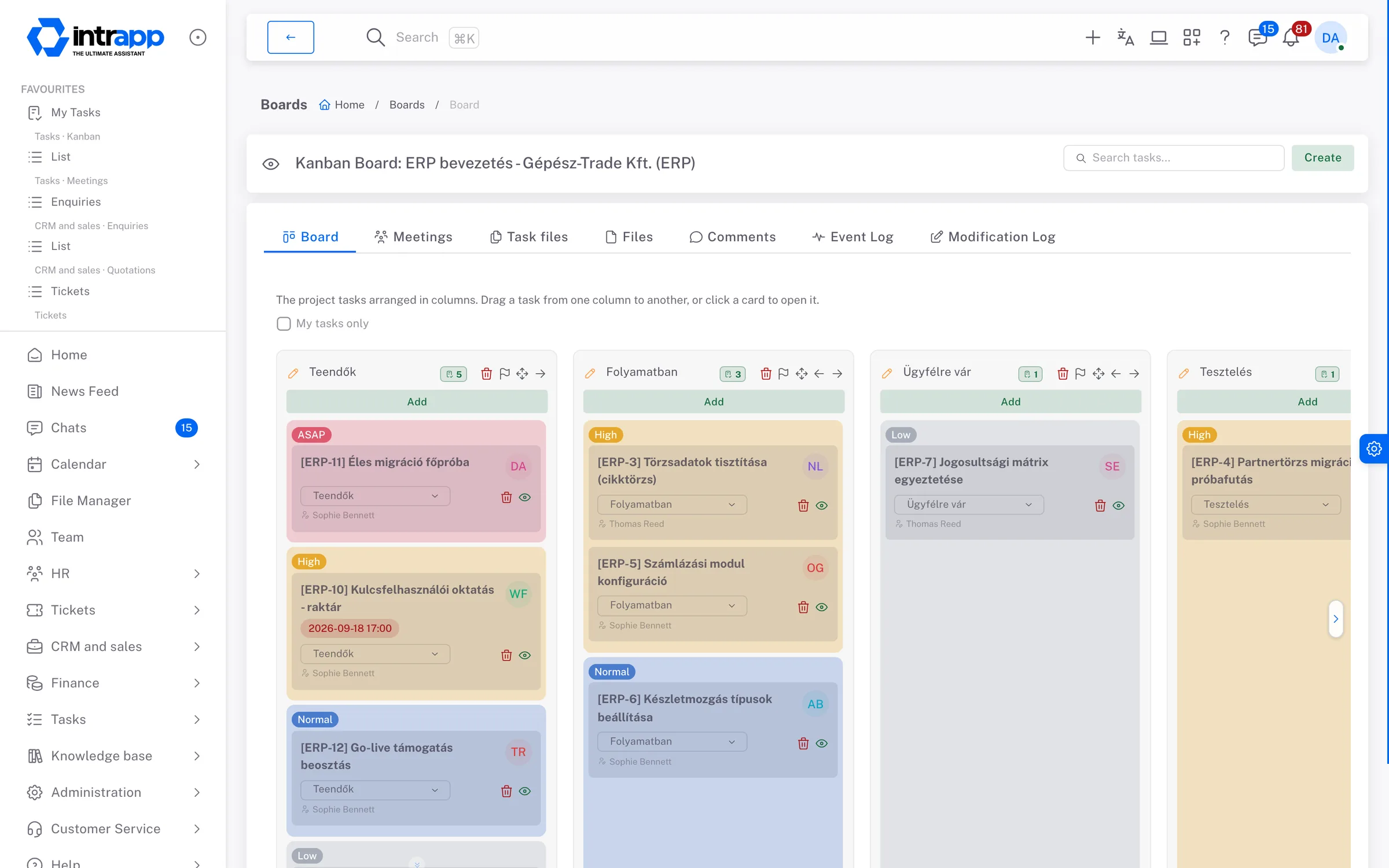
A kanban board with your own columns, and time logged to the minute. Both attached to the work they are about.
Details

Customers & partners

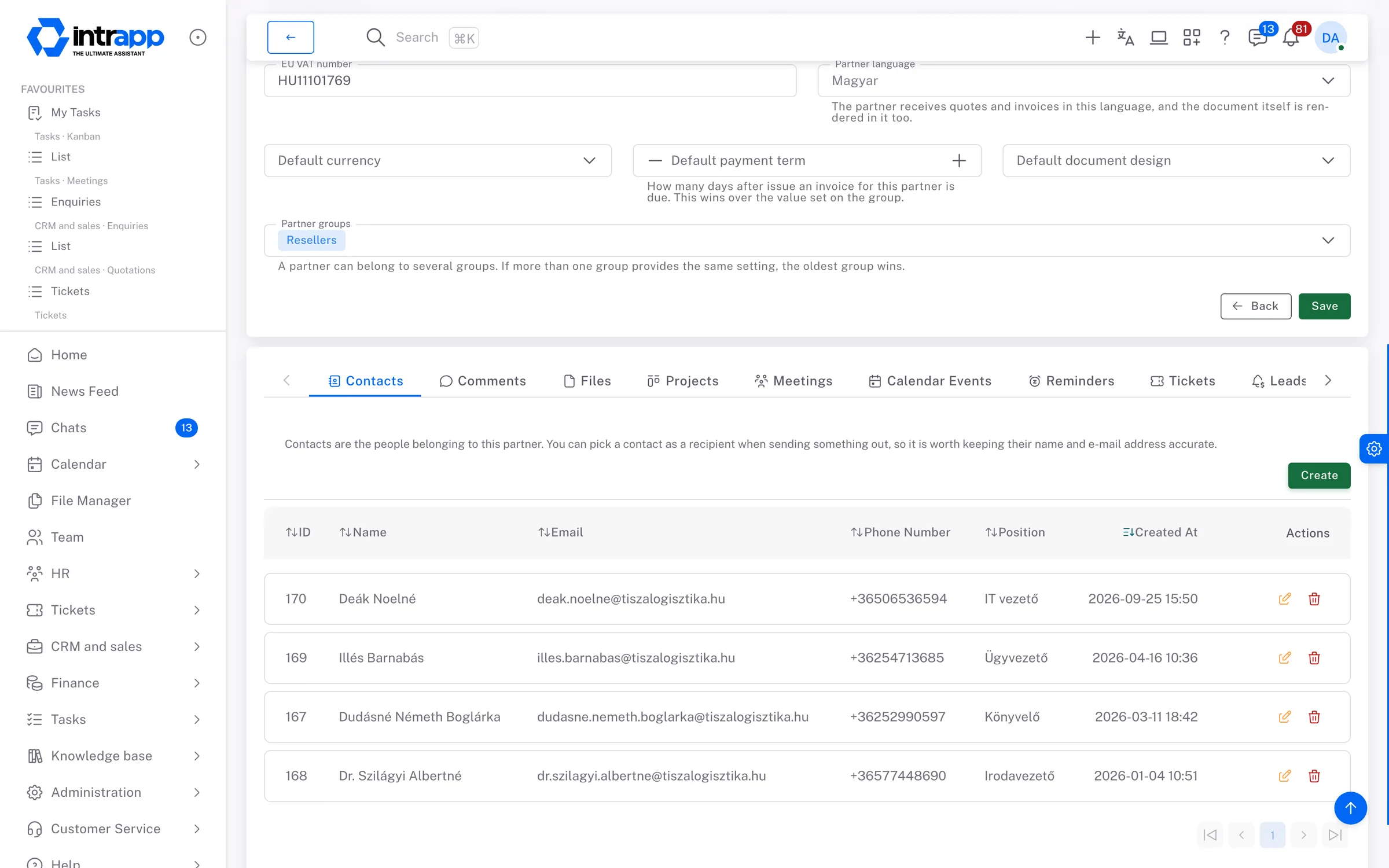
Customer records, enquiries, follow-ups, contacts and tickets. You can also see who promised what, and when.
Details

Knowledge base

An internal wiki for the processes and the questions that keep coming back. Written down once, not explained for the tenth time.
Details

Communication

Chat, message board, notifications and comments. What you agreed stays next to the task, not in a thread that has long scrolled away.
Details
When something is missing

A missing feature is not a dead end

You do not have to know today what you will need in three years. No system covers everything on day one. The question is not whether something will be missing, but what happens then. You write to us, and your request falls into one of two cases.

If others would use it too

If roughly three quarters of our customers would get use out of it, we build it for free, it goes into IntrApp and everyone gets it. We decide what counts as broadly useful, because we are the ones who see the whole customer base. What we promise is that it enters development, not that it ships next week.

If it is specific to you

We build that too, and that one is custom development. We talk through what is actually needed first, then you get a quote for it, so there is no surprise at the end. You can work out which case your request falls into before you even write. The custom development page walks through it.
What it costs

You pay per user, not per package

There are no tiers where one feature forces you into the expensive one. Every subscriber gets everything. The monthly figure depends on how many of you use it and how much storage you need.

When someone new joins, you do not move up a package, you pay for one more person. For a company of three that is roughly the price of a shared lunch each month.

You can work out your own figure on the pricing page.

The offer

We give you three months, not customer testimonials

We do not point to a long line of happy customers, because IntrApp is finished but the feedback from companies that actually run on it is still thin.

So anyone starting now gets three months of free trial instead of one, on their own data, with everything switched on. In return we ask you to tell us honestly what does not work. The offer is here.

Questions

Frequently asked questions

Does it need training?

No. There is a manual and a built-in walkthrough inside the application, so when something is unclear the app explains it at the point where you got stuck. No training day, and nobody has to become the in-house expert.

How long before we can use it?

The setup runs by itself and takes about half an hour. After that it is your IntrApp and you can start working in it. No six month rollout, and no five figure bill before you have seen whether it suits you.

Do we need you to run it?

No. You can get going on your own, and we do not bill for rollout or training. If you would like a hand, with the import or with setting up permissions, our specialists are glad to help. That is your call though, not the price of entry.

Is there a trial? How long do we get to decide?

A free month on your own data, with everything switched on, and three months through the honest offer. Long enough for the first week of enthusiasm to wear off and for you to see what people still open in week four.

What if it turns out not to be what we need?

You cancel it the way you cancel a streaming subscription. No notice period, no cancellation fee, and no reason required.

Take a look inside

We built a demo with the whole system already set up, with sample projects, sample customers and sample documents, so you can see how it fits together. No sign-up and no card, and you cannot break anything, because it resets every night. To see it on your own projects, that is what the trial is for.