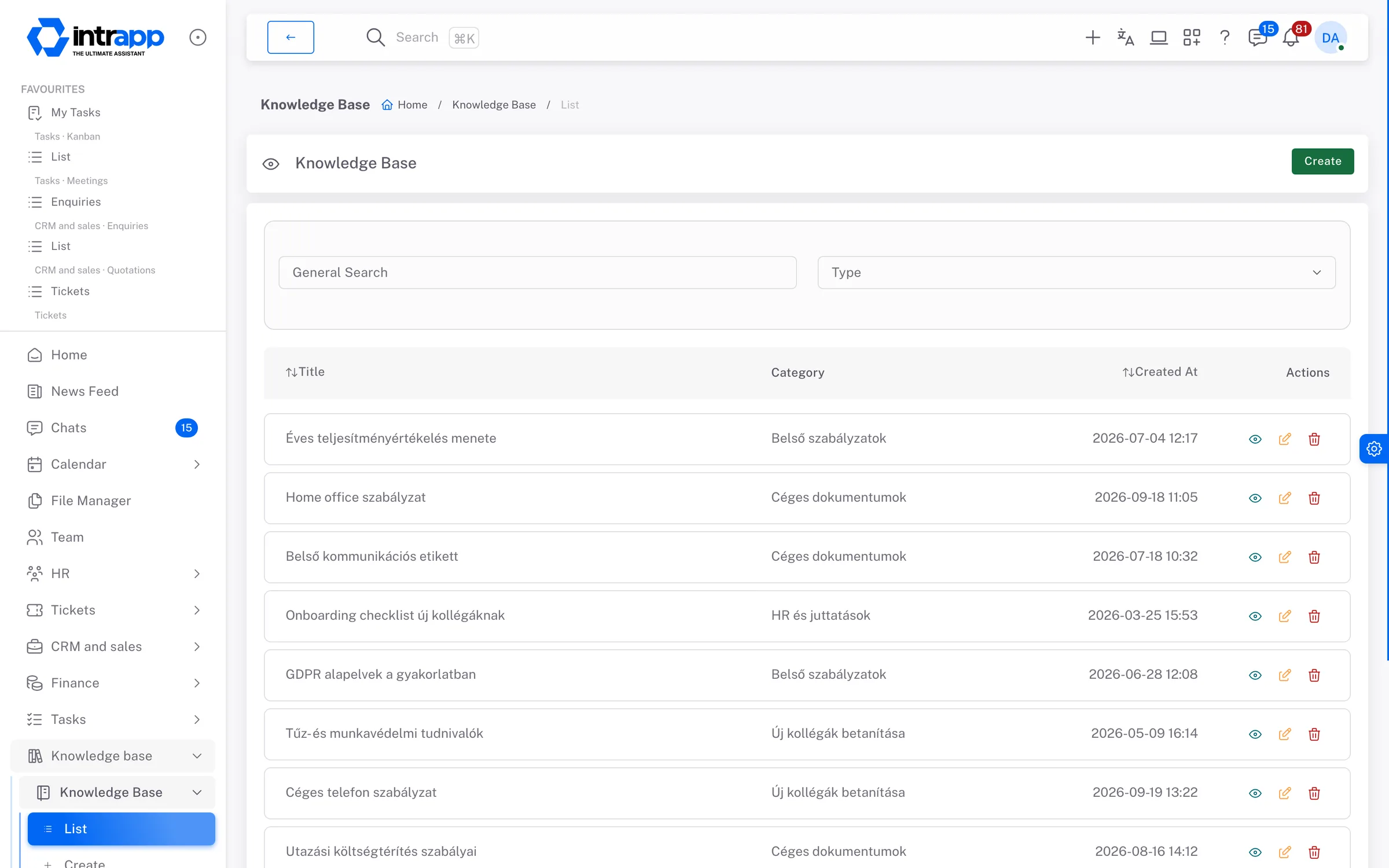
Knowledge base
What the company knows, in one place, next to the projects, the customers and the tasks. The internal wiki attaches to the daily work: the write-up sits where somebody will actually look for it, and the search reads the body of the article, not just its title.
What it actually solves
The question answered for the tenth time
Versions you cannot vouch for
The knowledge that resigns
Being found, not being elaborate
Traditional document systems arrive full of things that slow the day down: permission matrices, approval chains, metadata schemes. In a growing company the problem is not a missing archiving policy. It is that an important contract simply cannot be found. The goal was not to build something heavy, but to make sure everyone finds what they are looking for straight away.
Write it down once, so you do not explain it again
The knowledge base is your internal wiki: processes, rules, how-to guides and the answers to the questions that keep coming back, written as articles. Instead of asking you, the team asks the search box and finds the answer in seconds.
Categories in your own words
Formatted, with files attached
Onboarding from day one
One surface instead of separate storage
What makes it work is the connection to everything else:
- The written process and the operational notes that belong to it sit on one surface.
- Files attached to an article land in the same file and data handling as the contracts.
- A new colleague's first-week guide is where their tasks are, not in a separate application.
The knowledge base is deliberately flat
If you have access, you see every article. That is a decision, not an oversight. An internal wiki earns its keep by removing the question of whether you are allowed to read the process description, and nobody should have to maintain a permission matrix so that a colleague can find out how to book holiday. Files and notes work differently, because they are different things, and both are set out on their own pages.
Clean handling instead of unnecessary complexity
There are no approval chains, no retention policy and no compliance archive. If you work in a regulated industry and the lifecycle of your documents has to stand up to an audit, that calls for a dedicated system and you will be better off with one.
The knowledge base is for people inside the company, not a public customer portal. Nor does having somewhere to put the knowledge fill it: what realistically happens is that over the next six months you write down the twenty things you currently explain every week, and after that you are only keeping them current.
“What if the team does not use this one either?”
Most abandoned internal wikis died for the same reason: they lived in their own application, behind another password and another search box, in a tab nobody opens unprompted. Here the write-ups sit where the daily work and the tasks already are, which makes reading them part of the routine rather than a detour.
“Do we need training?”
“What does it cost to start?”
“How flexible is the trial?”
Ask for it, and you may not have to pay
If a template or a category is missing, you can write to us about it. Whatever roughly three quarters of our customers would use, we build for free, and every customer gets it. What is specific to you gets built under a separate agreement.
The demo is for looking, the trial is for deciding
They are not the same thing, and it matters which one you start with. To look around and get a feel for the screens, the demo is the better choice; to actually decide, you want the trial.