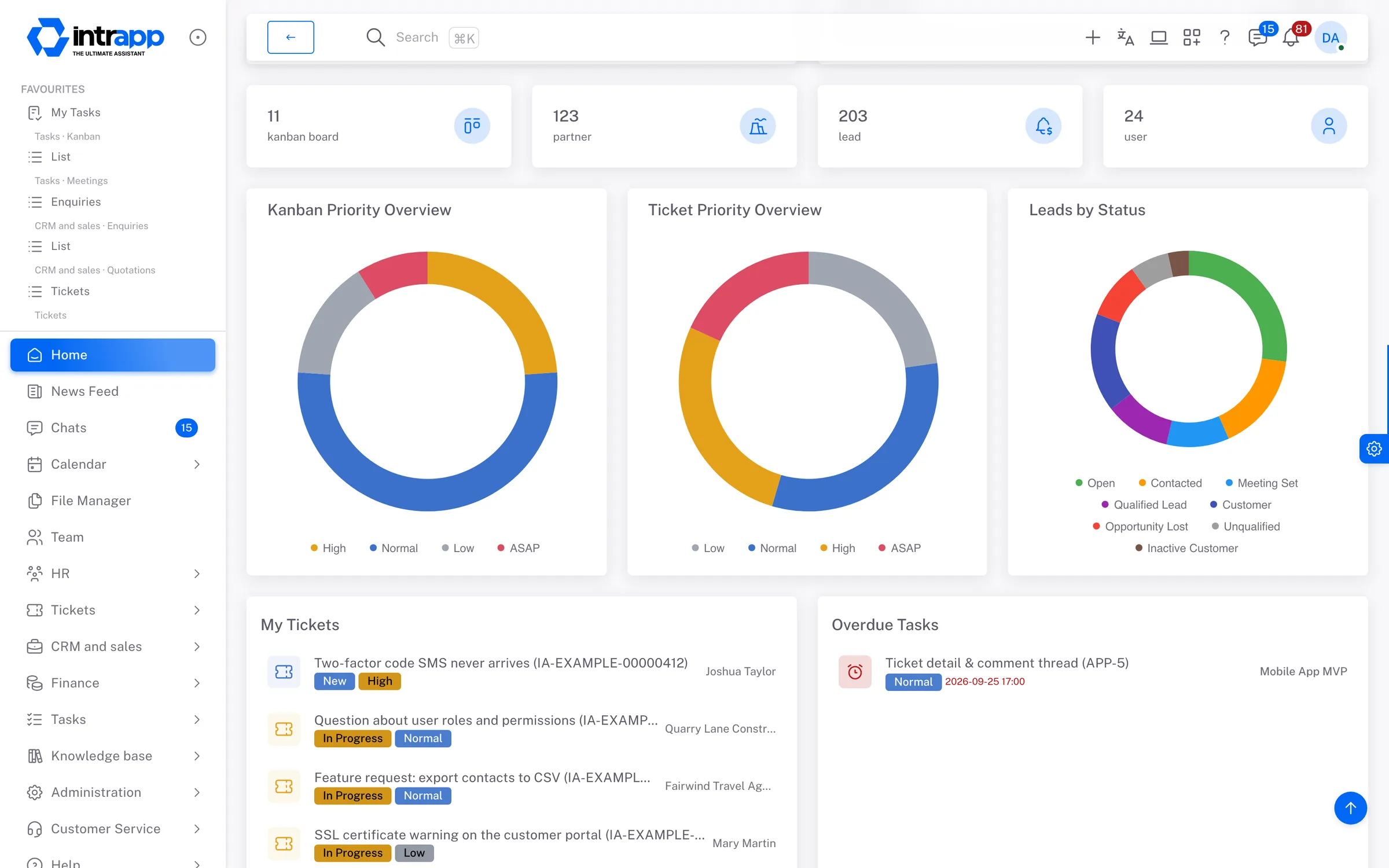
How does IntrApp work?
IntrApp brings together the applications you currently use separately into one clear, unified system.
It’s not about competition, it’s about fewer tools, faster workflows, everything in one place, so your team can focus on what truly matters.
What you manage today in separate systems works together in IntrApp
Fewer tools. Less data duplication. Fewer errors.
Tasks and Projects
In IntrApp, a task is never a standalone item. It is always connected to a project, a client, and a responsible person.
What does it replace?
Szétszórt teendőlistákat, külön nyilvántartásokat és elszigetelt projektkezelést.
How does it work?
- Tasks can be organized into projects
- Linked to a client
- Documents can be attached
- Communication can be recorded alongside them
- Clear deadline and responsible person assigned
What does it result in?
- Tasks no longer float separately
- Everything is traceable
- Clear and transparent workflows
Communication and Case Management
In IntrApp, communication is not a separate channel. It is always connected to a case, project, or task, so it never loses context.
What does it replace?
Scattered conversations, context-less email threads, separately tracked client communication, and time-consuming information searches afterward.
How does it work?
- Communication always happens within a specific case or project
- Conversations appear alongside the relevant item, in context
- The full history is searchable in one place
- All relevant team members see the same context
- Communication is part of the workflow, not a separate tool
What does it result in?
- Faster response times and fewer misunderstandings
- Transparent, traceable case management
- More consistent and professional operations
Permissions and Operational Control
A system works reliably only when everyone sees exactly what is relevant to their role.
What does it replace?
Unclear access rights, ad-hoc permission settings, excessive visibility, and ambiguous responsibilities.
How does it work?
- The system uses role-based access control
- Users only see the menus and data relevant to them
- Permissions can be managed centrally
- Operations can be aligned with projects, cases, and organizational structure
- Access rules are integrated directly into the system’s logic
What does it result in?
- Clearer responsibilities
- Greater data security
- A cleaner, more focused interface
Document and Data Management
Information has value when it’s accessible. In IntrApp, documents and data don’t live in separate folders, they are directly connected to your operations.
What does it replace?
Scattered file storage, versioning uncertainty, parallel data handling, and folder chaos.
How does it work?
- Documents can be directly linked to a project, task, or client
- Files and data appear alongside the relevant item, in context
- Structured data fields ensure consistent data entry
- Access can be controlled through a sharing and permission system
- Data and documents function as part of the system, not as a separate storage solution
What does it result in?
- No more scattered files and data
- Faster retrieval
- More transparent operations
Time and Transparency
Operations become transparent when every event is trackable, searchable, and clearly linked to a responsible person.
What does it replace?
After-the-fact explanations, unclear accountability, verbally agreed processes, and workflows that are difficult to reconstruct.
How does it work?
Time tracking
Work time is recorded in connection with projects and clients, so it’s clear exactly where time has been spent.
Calendar view
Events and deadlines can be created and reviewed in a calendar format.
Reminders
Reminders can be assigned to important events and deadlines, ensuring that critical tasks are not overlooked.
Activity log
The system records relevant changes and actions, with timestamps and linked users.
Traceability
The full history of a case or project can be reviewed in one place, without separate searches.
Planning capability
Based on time data and deadlines, capacity and resource allocation can be managed more consciously.
What does it result in?
- More transparent operations based on recorded data
- Better-planned workflows
- More measurable and intentional performance
Who is IntrApp for?
IntrApp is built for organizations where operations are intentional and the system is not an add-on, but the foundation.
Leaders and decision-makers
For those who:
- Want transparent operations
- Want to see where time and resources are spent
- Don’t want to piece together workflows from separate tools
What do they get?
- Greater overall visibility
- More measurable performance
- More predictable planning
Operational teams
For those who:
- Manage tasks and cases daily
- Don’t want to use multiple systems in parallel
- Prefer working with clear responsibilities
What do they get?
- Tasks managed in context
- Clear priorities
- Less time spent searching for information
Organizations where control matters
For those who:
- Think in structured operations
- Want knowledge to be system-based, not person-dependent
- Build long-term operational stability
What do they get?
- Traceable processes
- Role-based access control
- Stable, documented operations
Our Goal and Vision with IntrApp
After years of experience, one thing became clear to us: most SMEs want their own system — a place where all data, tasks, and client information can be managed in one location, transparently and securely.
The market is full of subscriptions, scattered tools, and disconnected applications. Companies switch between them daily, losing time, energy, and money in the process. We wanted to create a clear, partner-centered system that immediately supports the daily operations of SMEs — without overwhelming users with unnecessary complexity or redundant features.
IntrApp is built modularly, and it was especially important for us that it can integrate with virtually any other system — whether landing pages, eCommerce platforms, or any tool with a web-based connection point. This allows your existing systems and processes to connect seamlessly with IntrApp, so all data and workflows can be managed in one place.
During the design process, achieving a healthy balance between predictable costs and return on investment was a key priority. Following LEAN and MVP development principles, you only pay for what you truly need — and you remain in control. New modules, features, or custom developments always follow your company’s current priorities.
Our goal is for IntrApp to be more than just a system: a secure, intuitive, partner-centered platform that simplifies daily operations, integrates quickly with other systems, and grows alongside your business — supporting progress and expansion while keeping your investment transparent and predictable.