A company’s operations are not built only on processes and tools.
They are built on knowledge.
How problems are solved.
What experience the team has with customers.
What worked before — and what did not.
In most small and medium-sized companies, this knowledge is:
- stored in people’s heads
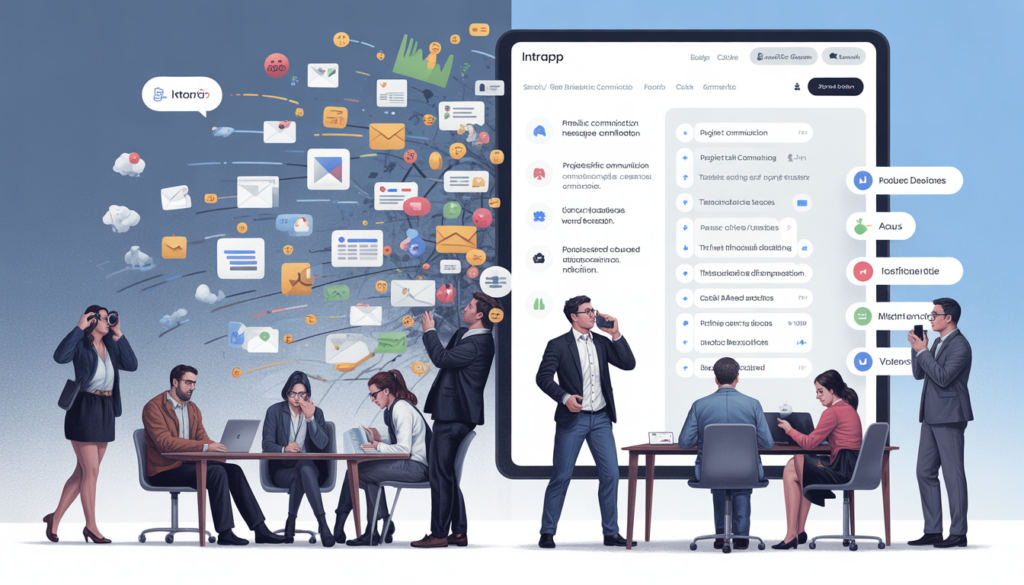
- scattered across emails
- buried in old chat messages
- or kept alive by the phrase “let’s just ask someone”
This may work in the short term.
But during growth, it becomes a serious limitation.
The hidden problem: knowledge exists but is not accessible
Losing internal knowledge rarely happens dramatically.
Nothing breaks overnight.
The system doesn’t collapse.
Things simply become slower.
Typical signs include:
- the same questions being asked repeatedly
- new employees feeling uncertain for weeks
- experienced colleagues constantly explaining things
- the reasoning behind decisions becoming impossible to trace
The knowledge exists – it just is not organized.
Onboarding: where the problem becomes obvious
Onboarding is usually the first place where this gap becomes visible.
A new employee arrives and:
- cannot find internal guidelines
- processes are unclear
- there is no place where everything connects
- they must ask questions about every small detail
This is not the new employee’s fault.
It is a system problem.
And it affects the entire team:
- experienced employees lose time explaining things
- independence develops slower
- the chance of mistakes increases
The idea behind Knowledge Space: a structured company memory
Knowledge Space is not just a collection of documents.
It is not another folder.
It is a structured, searchable, categorized internal knowledge base where:
- important information is stored in one place
- knowledge is not tied to individuals
- experience remains within the company
The goal of the IntrApp Knowledge Space is to:
- organize company knowledge
- make information easy to find
- support independent work
What can be managed inside Knowledge Space?
Knowledge Space supports an unlimited number of articles and entries, such as:
- internal process descriptions
- onboarding materials
- frequently asked questions
- customer management experiences
- technical documentation
- internal “how we do things here” guides
All content can be:
- categorized
- structured
- maintained over the long term
Not only useful for new employees
An important distinction: Knowledge Space is not just an onboarding tool.
It supports everyday work as well by providing:
- quick answers without constant questions
- consistent processes across the team
- fewer misunderstandings
- less reliance on informal knowledge sharing
Knowledge no longer becomes distorted, forgotten, or lost.
Knowledge equals scalability
A company becomes scalable when:
- knowledge can be transferred
- processes can be taught
- new employees can catch up quickly
If knowledge remains tied to individuals:
- growth becomes fragile
- employee absence becomes risky
- operations become unstable
Knowledge Space reduces these risks.
Why it is better than scattered notes and files
With separate documents and files:
- it is unclear which version is current
- searching is difficult
- context is missing
- there is no unified structure
Inside Knowledge Space:
- knowledge becomes part of a system
- it can connect to tasks and projects
- it can be structured logically
- it can grow over time
This is not additional administration.
It is operational infrastructure.
Summary
Internal company knowledge is:
- not secondary
- not something to organize “someday”
- not only an onboarding issue
Knowledge Space helps to:
- organize company know-how
- reduce repetitive questions
- accelerate onboarding
- stabilize operations
- keep valuable experience within the company
Knowledge only becomes valuable when it is accessible.
That is exactly what Knowledge Space provides.