Every development project is an investment.
The real question is not how much it costs — but whether it delivers a return.
Many small and medium-sized businesses lose money because they try to build too much at once:
too many features, overly long development cycles, and results that arrive far too late.
The LEAN mindset, MVP thinking, and agile development methodology help ensure that development stays controlled, business-driven, and measurable.
What is the LEAN mindset?
The core principle of LEAN is simple:
Minimize unnecessary features. Maximize business value.
In practice, this means:
- Avoid developing features that might be useful “someday”
- Focus on solving real problems
- Work in short development cycles
- Continuously measure and adjust
The goal is not to increase complexity – but to improve operational efficiency.
What is an MVP?
An MVP (Minimum Viable Product) is the simplest possible working version of a solution.
It is not a compromise.
It is not an unfinished product.
It is a testable, business-validatable solution.
Its main goals are:
- Faster deployment
- Faster feedback
- Lower risk
- Faster return on investment
An MVP helps determine whether a development idea actually creates value — before significant resources are spent on it.
Why is Agile methodology important?
Agile development ensures that:
- Work progresses in short iterations
- Priorities can adapt quickly
- Feedback can be incorporated immediately
- Development remains business-focused
For small and medium-sized companies, this is critical because operations change quickly.
Instead of executing a rigid long-term plan, development should adapt to real business needs as they evolve.
How do we measure return on investment?
Before starting any development project, it is important to define measurable goals:
- Does it save time?
- Does it reduce administrative work?
- Does it decrease the number of errors?
- Does it improve transparency?
- Does it increase revenue or conversion?
ROI is not only a financial metric.
Time savings, efficiency improvements, and better operational control are also measurable business value.
The biggest misconception: everything must start from scratch
Many companies hesitate to start development projects because they believe everything must be built individually:
- User permissions
- Role management
- Activity logging
- File management
- Data security
- Notification systems
- Basic CRM functionality
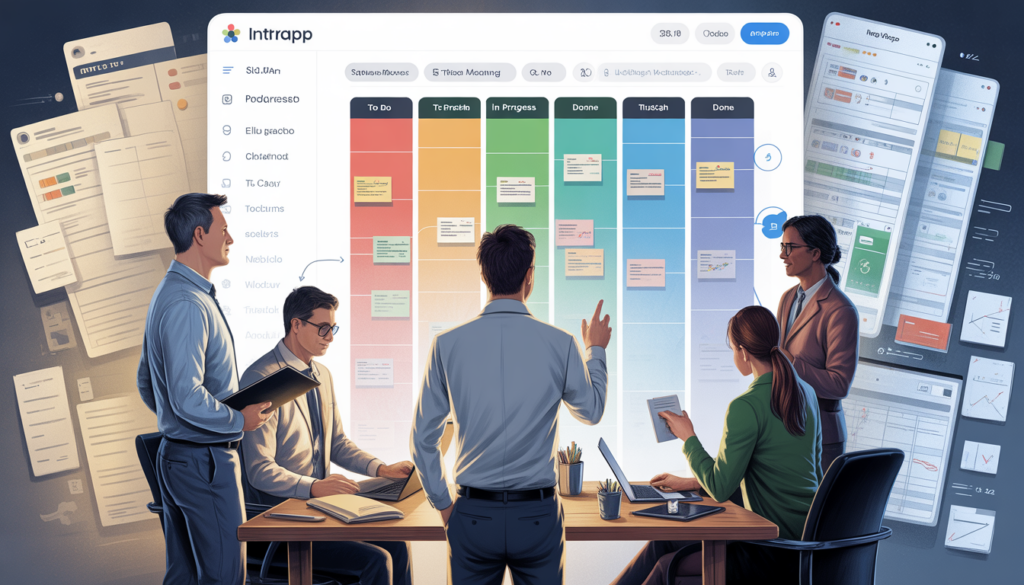
- Project and task management
- Access control levels
- Auditability
However, these are not competitive advantage features.
They are basic infrastructure components.
Rebuilding them from scratch every time significantly increases both cost and risk.
How this works with IntrApp
IntrApp already includes the core functionality most companies need:
- Role and permission management
- Detailed audit logging
- File management and document storage
- Basic CRM module
- Project and task management
- Internal communication tools
- Structured data management
- Modular extensibility
- Integrated workflows
This means development does not start from zero.
The focus shifts to unique business requirements – not rebuilding infrastructure.
Practical example
A small business wants to create a custom status-tracking system with automated notifications.
With IntrApp:
- No need to build a permission system
- No need to develop a separate logging solution
- No need to integrate file management
Only the unique business logic needs to be implemented as an MVP.
Development process:
- First version: basic status logic
- Internal testing with the team
- Measurement: time savings and error reduction
- Iteration: refinement and improvement
The result:
- Faster development
- Lower cost
- Faster ROI
Why modular systems matter
A modular architecture makes it possible to:
- Build MVPs quickly
- Extend functionality in a focused way
- Continuously optimize processes
- Scale the system over time
There is no need to implement everything at once.
The system can grow alongside the company.
Conclusion – Develop smarter with IntrApp
The goal of development is not to have more features.
The goal is to create more business value.
- LEAN thinking
- MVP-driven development
- Agile methodology
- Built-in enterprise foundations
- Modular scalability
IntrApp is not a development project that starts from scratch.
It is a stable foundation that allows companies to build solutions faster, with greater control and measurable results.
Don’t spend resources unnecessarily.
Build only what truly moves your team — and your business — forward.