
A company does not outgrow its systems overnight.
At first, things simply become inconvenient.
Then they become slow.
Eventually, they start holding back growth.
The real question is not whether your company is growing.
The question is whether your operations can keep up.
1. Administration takes more time than value creation
If your team spends time:
- updating Excel files
- copying data between systems
- manually preparing reports
- discussing project status through long email threads
then your operations are not optimized.
Growth should not require more administration –
it should require more automation.
2. You cannot see your operations in real time
If:
- customer statuses are not visible in one place
- project progress is unclear
- reports require gathering data from multiple sources
- decisions are made without up-to-date information
then your business lacks a central system.
Transparency is the foundation of scalable companies.
3. The team adapts to the system instead of the other way around
If people often say things like:
- “That’s just how the system works.”
- “There’s no other way to do it.”
- “We’ll fix it manually later.”
then the software is controlling your operations.
A well-designed business system should support your processes – not limit them.
4. The number of mistakes starts increasing
When tools are fragmented:
- duplicate data appears
- deadlines slip
- information gets lost
- communication misunderstandings occur
As companies grow, operational errors do not increase linearly – they increase exponentially.
5. Every attempt to scale requires reinvention
A new employee joins → a new Excel file appears.
A new service launches → another tool is added.
A new market opens → another workaround is created.
That is not scaling.
That is continuous firefighting.
A stable small or medium-sized company needs a modular and expandable foundation.
The real turning point
Your company has outgrown its current operations if:
- your system does not support automation
- CRM and project management are not integrated
- data is not centrally managed
- growth creates more chaos instead of more efficiency
At this point, you do not need another tool.
You need system-level thinking.
What does system-level operation mean?
- Integrated CRM
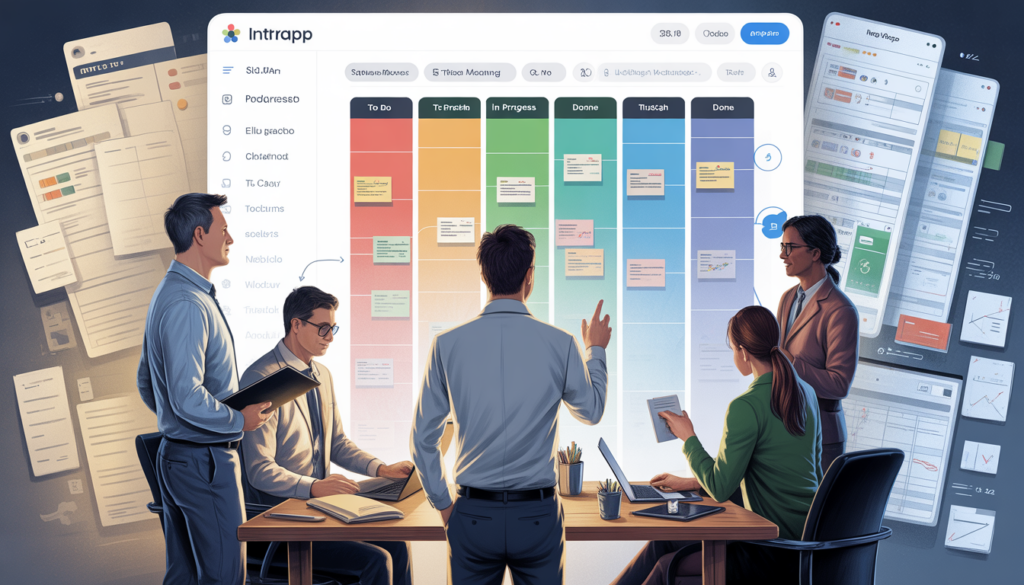
- Project and task management on one platform
- Automated workflows
- Role and permission management
- Centralized data control
- Scalable infrastructure
How IntrApp helps
IntrApp is designed specifically for small and medium-sized businesses that:
- have outgrown Excel
- use multiple disconnected tools
- want to automate their processes
- are looking for an integrated and modular business platform
IntrApp helps by:
- replacing multiple tools
- providing unified data management
- offering automated workflows
- enabling modular expansion
- scaling together with your company
It is not an overly complex enterprise system.
It is not a rigid boxed solution.
It is a flexible platform built around how your company actually works.
If you want to objectively evaluate whether your company has truly outgrown its current operations, a short system and process audit is often the best starting point.
In many cases, 30 minutes is enough to identify where the most time and money are being lost.