
Introduction
Many small and medium-sized businesses believe that every business problem needs its own tool: a CRM for customer relationships, another application for project management, a chat tool for team communication, and separate platforms for invoicing or document management.
In the short term, these tools can indeed be helpful.
But in the long run, having too many disconnected systems often leads to chaos and reduced operational efficiency.
What is the problem with too many separate applications?
1. More accounts, more passwords – more frustration
Every new application means another account, another password, and another login routine for employees.
This is not only a time loss due to constant context switching, but it also increases the risk of shadow IT, when employees start using unapproved tools simply because they are easier to access.
That can lead to security risks and data loss.
2. Data becomes fragmented – data silos appear
If:
- sales data is stored in the CRM
- project status is tracked in a project management system
- notes are saved in another tool
then the company no longer has a single source of truth.
As a result:
- reporting becomes slower
- data must be gathered from multiple systems
- decision-making takes longer
This is especially problematic for companies that rely on agile operations and fast feedback loops.
3. Integration challenges and redundant work
To make separate tools work together, companies often need technical integrations:
- APIs
- middleware solutions
- manual data imports
This typically:
- increases the workload of IT teams
- introduces errors (such as incorrect data copying)
- requires additional licenses or integration tools
According to research from Gartner, companies often spend more on underutilized software tools than they would on a consolidated platform.
The hidden costs of operational chaos
Lost time and duplicated work
When employees must manually transfer data or compare reports from multiple tools, hours of productive work are lost every week.
Financial risks caused by errors
Even small data inconsistencies can result in:
- incorrect invoices
- inaccurate project estimates
- misleading KPI measurements
Reduced collaboration
When teams work in different systems, communication becomes harder and slower.
This negatively affects team collaboration and overall productivity.
When should a company switch to an integrated system?
1. When the team grows
As the team expands, misunderstandings and time lost due to context switching increase rapidly.
Studies show that fragmented tools can reduce efficiency by 20–40% in growing teams.
2. When real-time decision making becomes necessary
In a unified platform where all data is accessible and updated in real time, it becomes much easier to:
- measure KPIs
- respond quickly to changes
- make better project management decisions
3. When multiple software licenses become too expensive
Many companies subscribe to 7–12 different business applications.
This not only increases costs but also consumes time and mental energy, while many features remain unused.
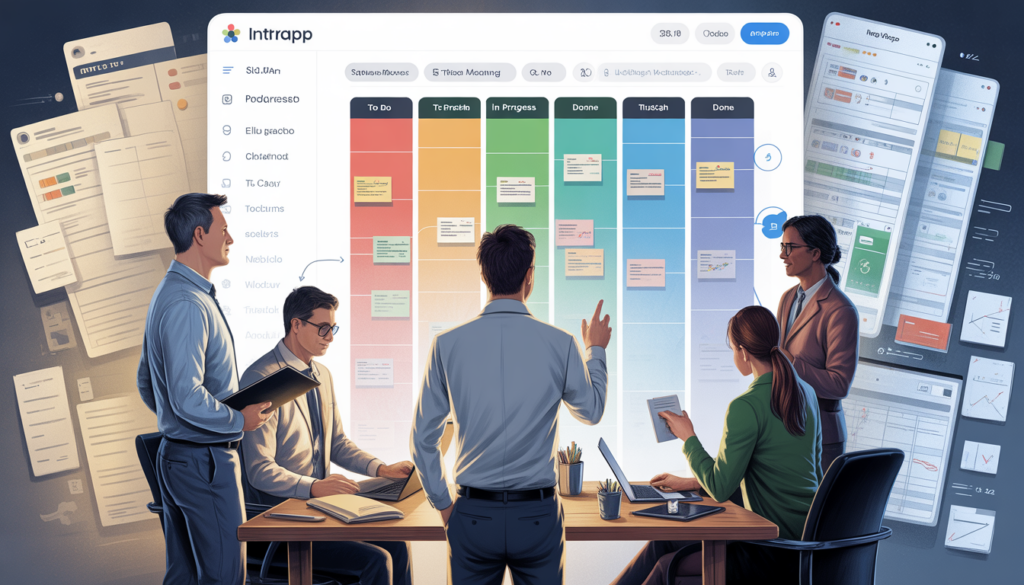
The solution: a unified platform like IntrApp
A system that integrates:
- communication
- task management
- CRM
- document management
- reporting
into one interface can:
- minimize context switching
- ensure unified data management
- reduce operational complexity
The result is:
- faster collaboration
- fewer mistakes
- more productive operations
Instead of juggling multiple productivity tools and project management systems, companies can rely on a single integrated platform that supports long-term growth.
Final thought
Using multiple separate applications may seem convenient in the short term.
However, over time it leads to errors, time loss, and hidden operational costs.
Modern companies increasingly move toward integrated platforms that provide a complete overview and control of their operations in one place.
That is why many small and medium-sized businesses today are replacing fragmented software stacks with unified business systems.